- Home
- Blog


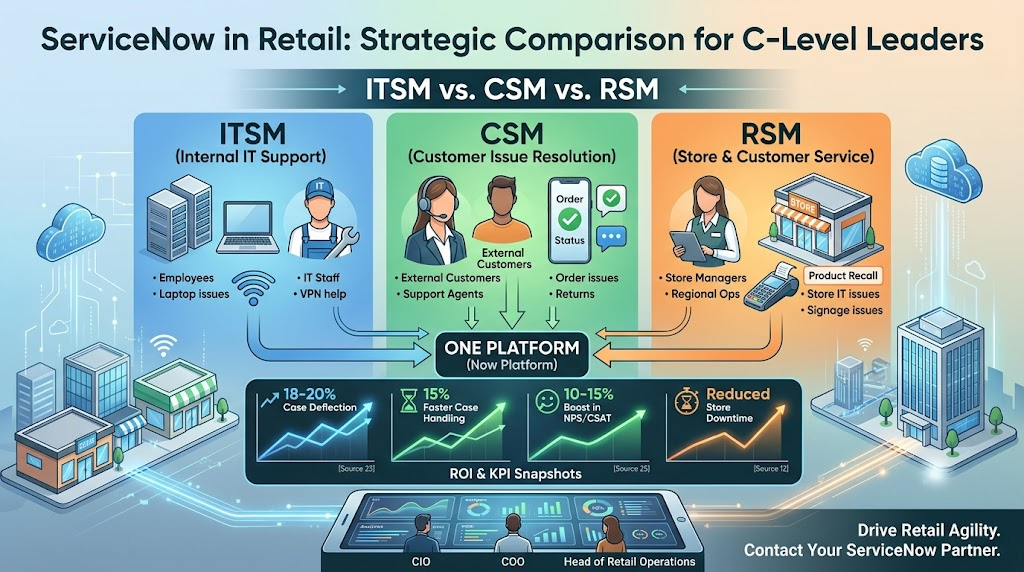
Retail enterprises thrive on operational efficiency, consistent customer experience, and agility in supporting store operations. While many retailers have invested in ServiceNow IT Service Management (ITSM) for internal IT support, evolving business models and heightened customer expectations call for a shift to Customer Service Management (CSM) and its retail-specific extension, Retail Service Management (RSM). This readout provides:
Core Comparison: ITSM vs. CSM vs. RSM in Retail
Areas | ITSM | CSM | RSM |
Core Focus | Internal IT support (devices, apps) | Customer issue resolution | Store and customer service across retail HQ, stores, and digital channels |
End Users | Employees, IT staff | External customers, support agents | Store managers, regional ops, HQ support teams, and customers |
Use Cases | Laptop issues, Wi-Fi problems, VPN help | Order issues, returns, loyalty questions | Store IT issues, fixture repairs, signage issues, product recalls |
Self-Service Portal Access | Internal employees | External customers | Store employees + customers via branded portals |
Core Data Models | Users, Incidents, CMDB, CIs | Accounts, Contacts, Entitlements, Cases | Stores, Sites, Retail Cases, Merchandise Categories |
KPIs & Outcomes | MTTR, SLA compliance, ticket volumes | CSAT, NPS, FCR, self-service deflection | Store downtime reduction, SLA resolution by HQ, omnichannel CX |
Licensing | ITIL fulfillers (named users) | Customer service agents (named) | RSM SKU (includes CSM + retail overlay) |
C-Level Decision Framework: When to Move from ITSM to CSM/RSM
If you already use ITSM, use the following framework to assess CSM/RSM adoption:
Trigger Question | Decision Signal |
Are stores reporting issues via email or spreadsheets to HQ teams? | Adopt RSM for structured store case intake |
Are store-level IT or facility issues impacting customer experience? | Extend RSM to track store-originated service cases |
Are customer support teams using disjointed tools (CRM, spreadsheets, email)? | Consolidate into CSM for a unified service platform |
Are there frequent handoffs between customer support and IT for resolution? | Use CSM+ITSM integration to streamline case-to-incident workflows |
Is there demand for omnichannel support (web, mobile, chat, in-store)? | Use CSM to enable consistent customer experience |
Do you want to measure CSAT/NPS tied to specific stores or regions? | Use RSM with store-mapped metrics |
Is your ITSM system being stretched to serve external (non-employee) users? | Transition external service to CSM to comply with licensing and data models |
ROI and Licensing Justification
Q: Why can’t we keep using ITSM for everything?
A: ITSM is optimized for internal IT support. CSM introduces a customer-focused data model, engagement tools, and KPIs. Using ITSM for external service breaks best practices and may breach license terms.
Q: When should we consider RSM vs. just CSM?
A: RSM is ideal when your store operations rely heavily on HQ coordination and you want to track site-specific issues and performance.
Q: How does CSM connect with our ITSM instance?
A: CSM and ITSM run on the same Now Platform. A CSM case can auto-generate an ITSM incident/problem when the root cause is technical.
Q: What’s the licensing impact?
A: ITSM and CSM use separate fulfillers. However, a CSM license allows users to work on both cases and incidents.
Q: Will this require a big implementation?
A: CSM implementations are modular. Start with a pilot use case (e.g., order tracking or store facility issues) and scale.
Retailers who use ServiceNow ITSM are poised to take the next step: unifying store and customer service through CSM and RSM. By separating internal and external service models while remaining on one platform, you’ll unlock faster resolution, better visibility, and stronger customer loyalty.
Recommendation: Start with a CSM pilot focused on a critical customer-facing process. If you operate a physical store network, layer RSM to connect store ops with customer experience. The platform is ready. The value is proven. The shift is strategic.
For a tailored roadmap or workshop with your retail ops or service leaders, contact your ServiceNow solutions partner or account executive.
We understand the importance of approaching each work integrally and believe in the power of simple and easy communication.


©2025 - Bourntec Solutions Inc, All Rights Reserved.